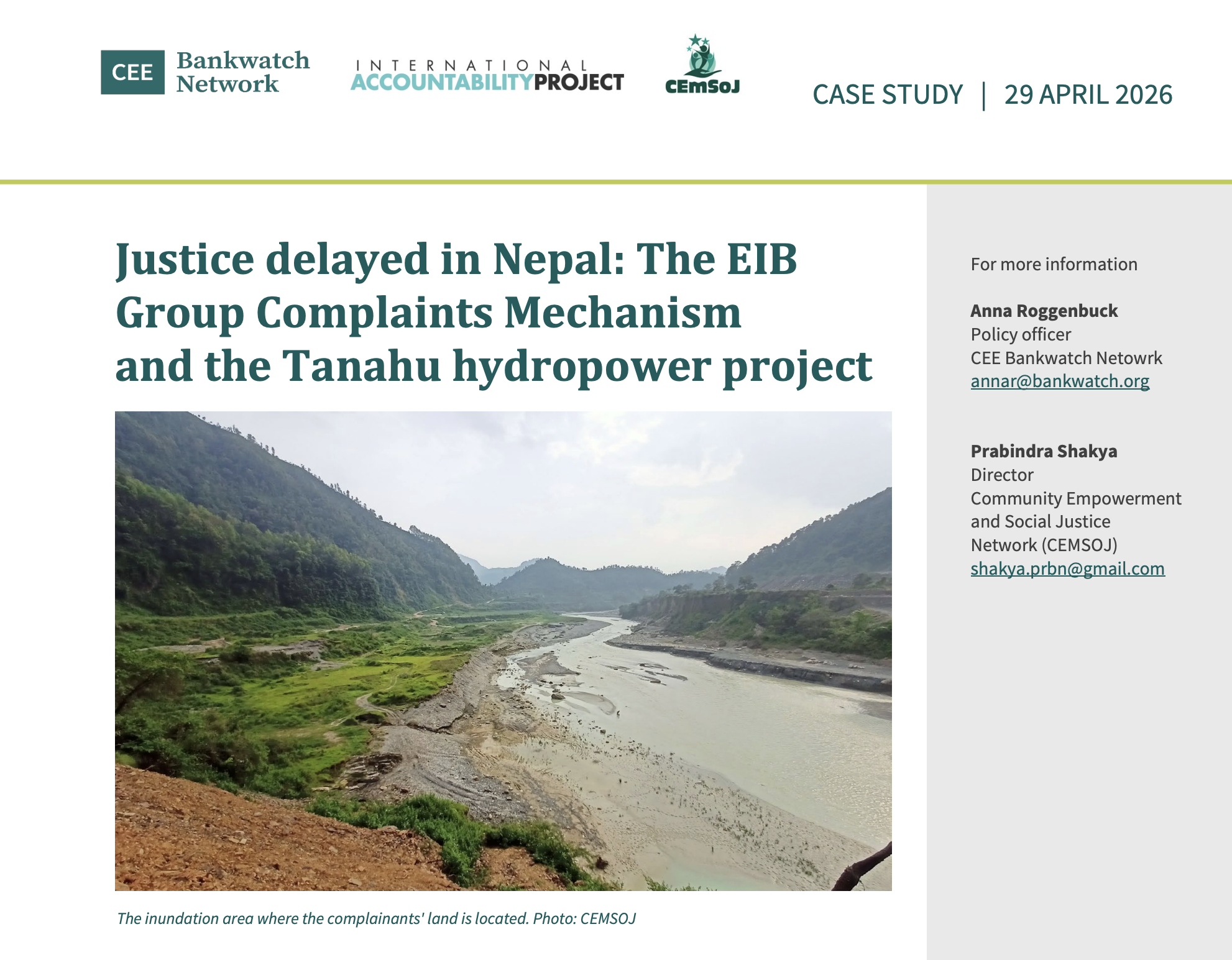
Justice delayed in Nepal: The EIB Group Complaints Mechanism and the Tanahu hydropower project

The European Investment Bank (EIB) co-financed Tanahu hydropower project in Nepal has impacted Indigenous Magar and other communities against the Bank’s environmental and social standards. Communities impacted by the project’s inundation have filed complaints with the EIB Group Complaints Mechanism (EIB-CM) – without success. 

more “Justice delayed in Nepal: The EIB Group Complaints Mechanism and the Tanahu hydropower project”

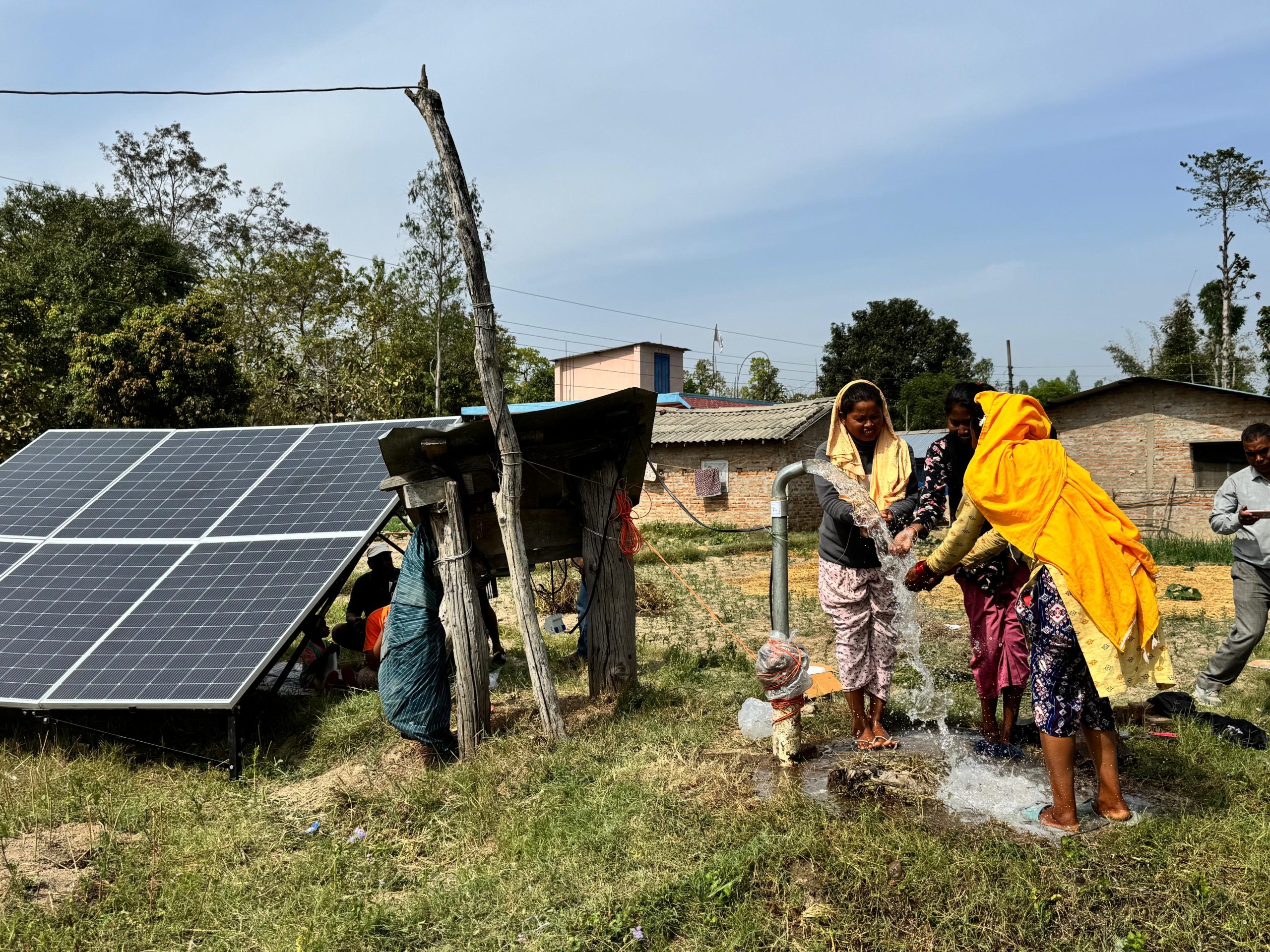
Solar Irrigation Pump distribution in Gulariya and Madhuwan, Bardiya (CbREP Phase 4)

From March 15–17, under Community-based Renewable Energy Project (CbREP) initiative Phase 4, CEMSOJ handed over solar irrigation pumps to and conducted orientation on the use thereof for Tharu women farmers’ groups in Bardiya district, south-western Nepal advancing both renewable energy adoption and women’s economic empowerment.

more “Solar Irrigation Pump distribution in Gulariya and Madhuwan, Bardiya (CbREP Phase 4)”

Recommendations to the draft rules of KfW Development Bank’s Complaint Mechanism

On 6 February 2026, CEMSOJ, Defenders in Development campaign and others submitted their recommendations to the draft rules of procedure for KfW Development Bank’s Complaint Mechanism, based on the concerns that emerged in the analysis “KfW: Irresponsible Banking” (September 2025). The submission highlights serious concerns about the lack of independence, effectiveness, and accessibility of KfW Development Bank’s proposed Complaint Mechanism.

more “Recommendations to the draft rules of KfW Development Bank’s Complaint Mechanism”

Indigenous Newa and other communities file complaint with the Asian Development Bank over its financing for projects related to Bagmati and other river corridors

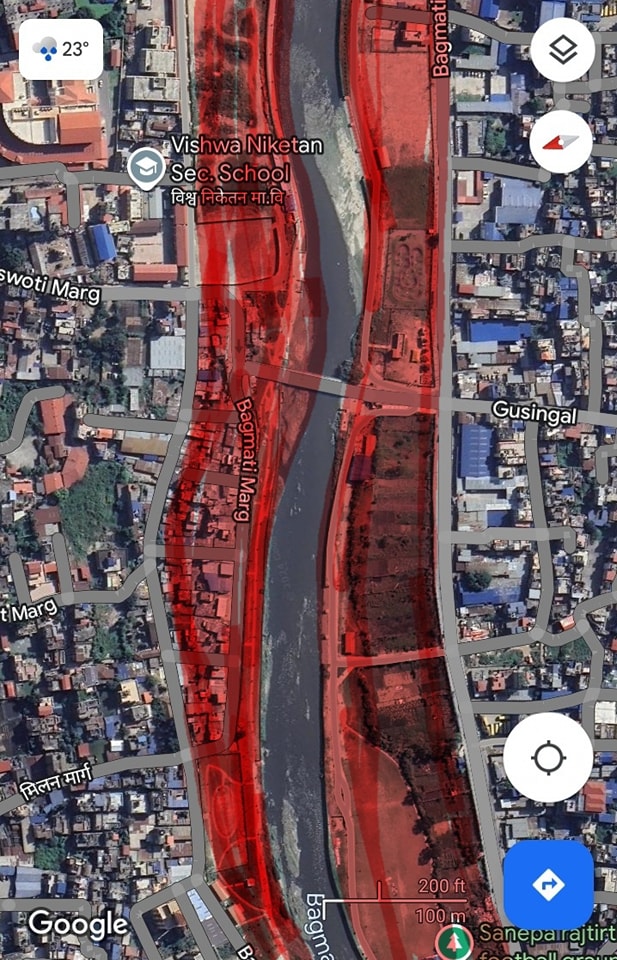
Indigenous Newa and other locals affected by Bagmati and other river corridors across Kathmandu valley have filed a complaint to the Asian Development Bank (ADB) regarding violations of its safeguards in the Bagmati River Basin Improvement Project and other associated projects it finances related to the river corridors.

In a letter submitted to the ADB’s Nepal resident mission on Thursday, representatives of the committees of those affected by the no-construction and buffer zones imposed along the banks of the Bagmati river and its tributaries have called on the ADB for immediate actions to resolve their grievances in relation to the impacts faced by and concerns of the communities along the river corridors, including the following:

more “Indigenous Newa and other communities file complaint with the Asian Development Bank over its financing for projects related to Bagmati and other river corridors”

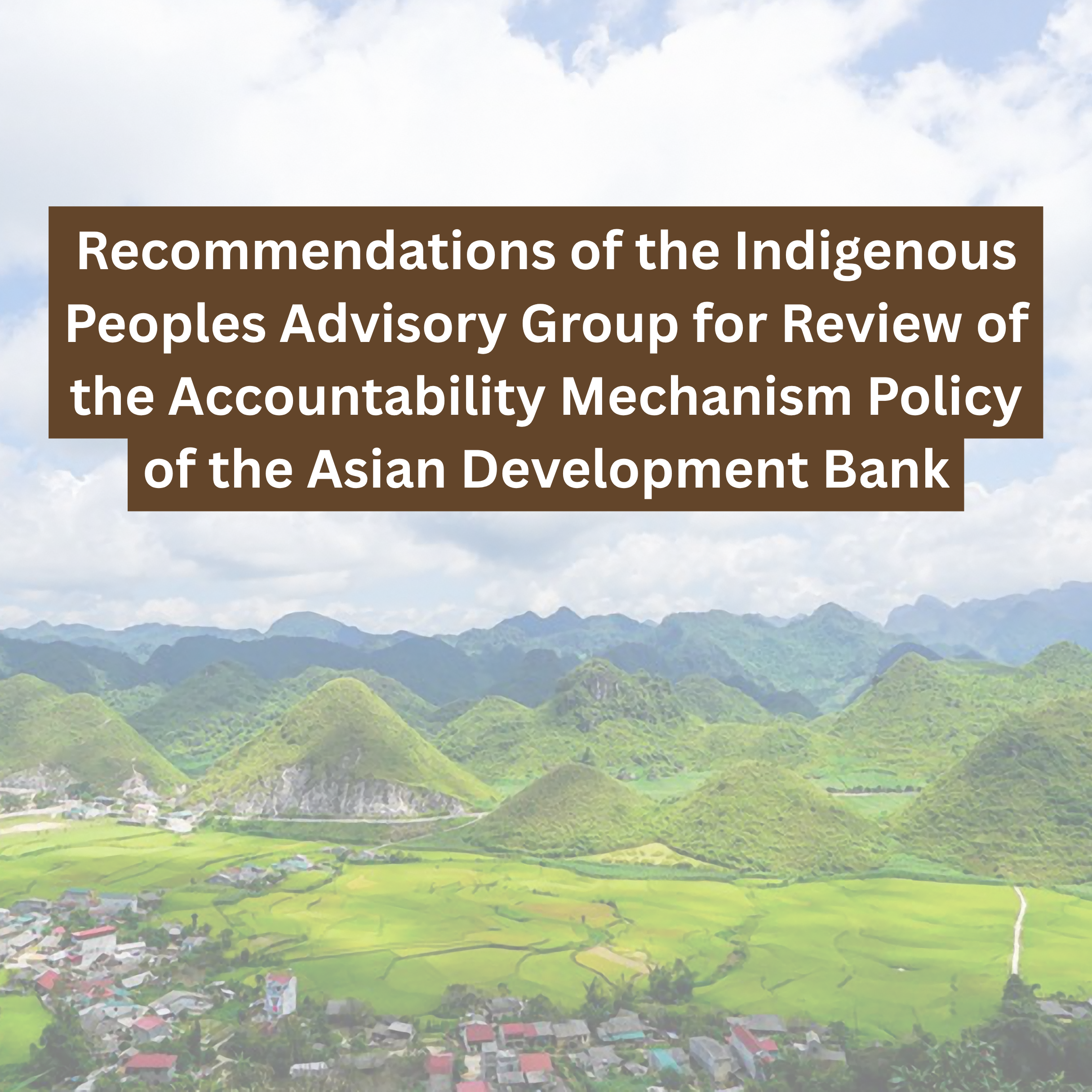
Recommendations of the Indigenous Peoples Advisory Group for Review of the Accountability Mechanism Policy of the Asian Development Bank

July 16 2025

We, members of Indigenous Peoples of Asia and the Pacific, Indigenous rights defenders, and representatives of Indigenous Peoples Organizations, having engaged in the ongoing review of the Accountability Mechanism (AM) Policy (2012) of the Asian Development Bank (ADB) through the Indigenous Peoples Advisory Group (IPAG) present the following preliminary recommendations for the Policy review.

more “Recommendations of the Indigenous Peoples Advisory Group for Review of the Accountability Mechanism Policy of the Asian Development Bank”

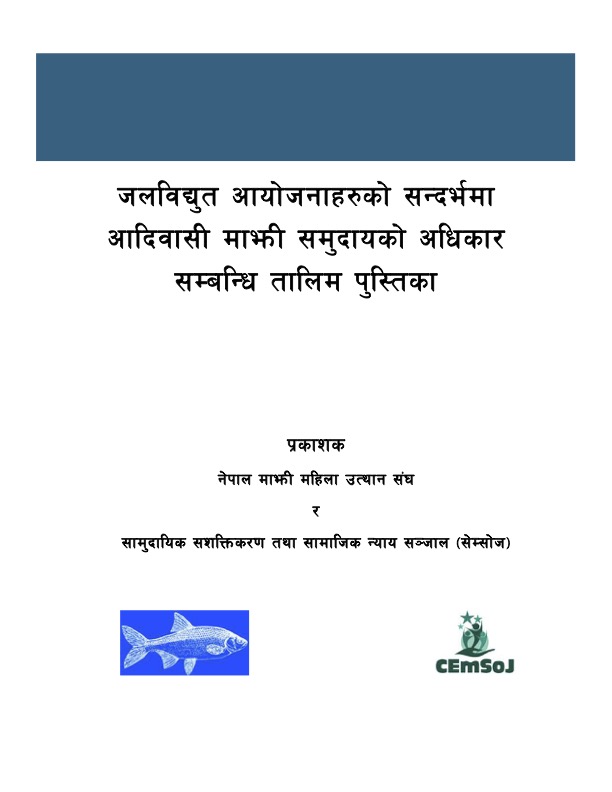
जलविद्युत आयोजनाहरुको सन्दर्भमा आदिवासी माझी समुदायको अधिकार सम्बन्धि तालिम पुस्तिका

वि.सं. २०८१ चैत १५

जलविद्युत आयोजनाहरुको सन्दर्भमा आदिवासी माझी समुदायको अधिकार विषयक यस तालिम पुस्तिकाले आदिवासी माझी समुदायलाई सशक्त बनाउनको लागि एक बृहत् स्रोतको रुपमा काम गर्ने उद्देश्य लिएको छ । यसले जलविद्युत परियोजनाहरूको प्रभावको सन्दर्भमा समुदायको अधिकारको वकालतको लागि जनचेतना अभिबृद्धि र क्षमता विकासको लागि तत्काल रहेका आवश्यकताहरूलाई सम्बोधन गर्ने लक्ष्य राखेको छ । यो पुस्तिका माझी समुदायका अगुवा, अधिकार प्रतिरक्षक र अन्य मानवअधिकार तथा आदिवासी अधिकार प्रतिरक्षकहरूलाई सुनकोशी–३ र दुधकोशी जलविद्युत आयोजनाहरूको सम्बन्धमा बुझाई वृद्धि, अन्तर्राष्ट्रिय र राष्ट्रिय कानून अन्तर्गत आदिवासी जनजातिको अधिकारको प्राविधिक ज्ञान, व्यवहारिक वकालत, तालिम र जनचेतना अभिबृद्धिका लागि सीप विकासमा सहयोग गर्न तयार पारिएको छ ।

more “जलविद्युत आयोजनाहरुको सन्दर्भमा आदिवासी माझी समुदायको अधिकार सम्बन्धि तालिम पुस्तिका”

Displaced and Landless: Endangered Indigenous Bankariya living in the buffer zone of Parsa National Park in Nepal

This summary report aims to analyze the human rights challenges of Nepal’s endangered Indigenous Bankariya people, particularly to their lands and forest resources, due to Parsa National Park in the south of the country. Traditionally a nomadic group living in forests, Bankariyas were provided six hectares of leasehold forests, where they currently live in informal settlements. The leasehold forests were later incorporated in the buffer zone of the Parsa National Park. Almost two decades later, Bankariyas now face the same challenge as around 6 million people of 34 districts living in buffer zones of various protected areas of Nepal. They do not have titles to the lands that they have been living on, using or occupying for generations. As a result, they face threats of forced evictions and displacement from their current settlement upon expiry of their lease and in lack of land titles.

more “Displaced and Landless: Endangered Indigenous Bankariya living in the buffer zone of Parsa National Park in Nepal”

Indigenous Peoples voice concerns on the revised Environmental and Social Framework of the Asian Development Bank

“Without strong safeguards, ADB-financed projects will continue to adversely impact Indigenous Peoples lands, livelihoods, and ways of life”

The Indigenous Peoples Advisory Group (IPAG) issued a statement urging the Asian Development Bank (ADB) to strengthen protections for Indigenous Peoples in the recently released revised ADB Environmental and Social Framework, now open for public consultation. Although IPAG welcomed certain improvements, including the integration of Free, Prior, and Informed Consent (FPIC) in certain ADB-financed projects and a separate section on Cultural Heritage, the group argues that the revisions fall short of adequately safeguarding Indigenous Peoples rights.

more “Indigenous Peoples voice concerns on the revised Environmental and Social Framework of the Asian Development Bank”

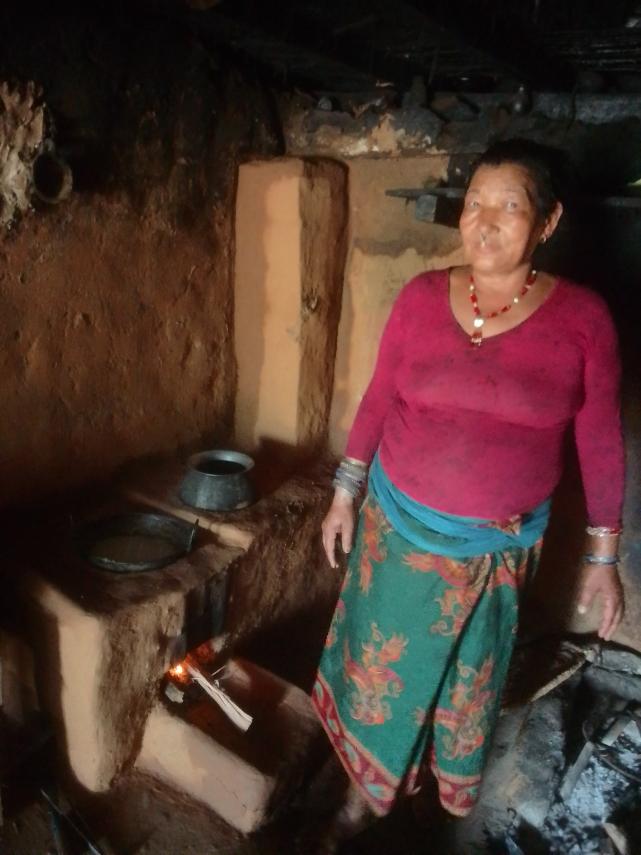
Improved Cooking Stoves training provided and construction undertaken at Chyaurang village in Makwanpur

On 25 May 2024, CEMSOJ provided a training on construction and maintenance of Improved Cooking Stove to Indigenous Tamangs and Chepangs of Chyaurang, Saleni Taar and Sukhel villages of Raksirang rural municipality in remote hills of Makawanpur district in southern Nepal. The Stoves are aimed to particularly benefit Indigenous women of the villages of Ward no. 9 of the rural municipality.

more “Improved Cooking Stoves training provided and construction undertaken at Chyaurang village in Makwanpur”

Case Study: Tourism and Indigenous Peoples’ Rights in Nepal

Tourism industry plays and can further play a significant role for Nepal’s economy and prosperity, including in terms of environmental conservation. However, the industry has often entrenched marginalization of Indigenous Peoples in the country and resulted in violations of their rights, including in the context of establishment of protected areas, tourism establishments and businesses as well as representation of Indigenous image.
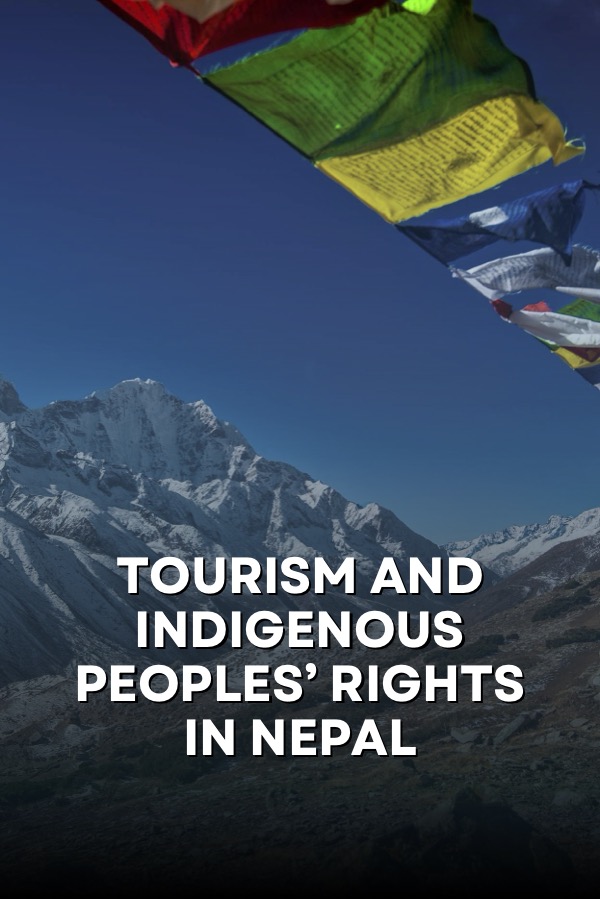
On many occasions, Indigenous Peoples have suffered loss of traditional lands and other violations of their rights in favor of tourism projects, which directly affects their lives and livelihoods. Particularly relevant is the establishment of protected areas, which have been mostly created by displacing Indigenous communities from their lands and resources. Concerningly, Indigenous communities have even been subjected to wide range of abuses, including killings, torture, arbitrary detentions, mistreatment, harassment as well as sexual violence against women at the hands of army, forest rangers and others in the context protected areas set up for environmental conservation and tourism.

Tourism establishments and business have also encroached upon lands and sacred sites of Indigenous communities in various parts of Nepal. Indigenous defenders and activists have faced retaliations and reprisals for raising their voices against violations of their rights and those of their communities in the context of such tourism undertakings, including at the hands of businesses.

more “Case Study: Tourism and Indigenous Peoples’ Rights in Nepal”