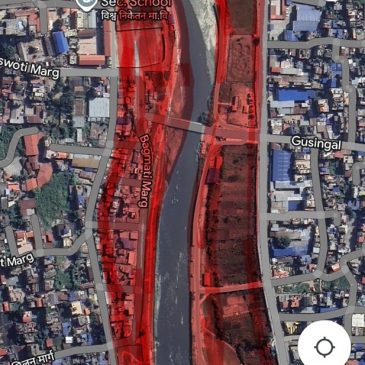
Indigenous Newa and other locals affected by Bagmati and other river corridors across Kathmandu valley have filed a complaint to the Asian Development Bank (ADB) regarding violations of its safeguards in the Bagmati River Basin Improvement Project and other associated projects it finances related to the river corridors.
In a letter submitted to the ADB’s Nepal resident mission on Thursday, representatives of the committees of those affected by the no-construction and buffer zones imposed along the banks of the Bagmati river and its tributaries have called on the ADB for immediate actions to resolve their grievances in relation to the impacts faced by and concerns of the communities along the river corridors, including the following:
- Lack of information and clarity about no-construction zones along the banks of Bagmati and other rivers and tributaries as per the government guidelines and the additional 20-meter buffer zone as per the recently published 2023 Supreme Court order
- Determination of the government guidelines for the no-construction zones along the riverbanks without consultation with the affected communities or their representatives infringing their right to participation in decision-making affecting them
- Violations of their right to property over their lands along the riverbanks due to imposition of no-construction or buffer zones while those lands are used for river corridor roads/footpaths and river beautification works such as establishment of parks.
- Impacts on their businesses and lives due to imposition of no-construction or buffer zones along the riverbanks that has caused devaluation of our properties, mental and psychosocial pressure and other impacts on their wellbeing and lives.
- Encroachment of river corridors for construction of new structures such as stadium and building (at Bagmati Manohar Dovan), parking area, ward office and new temples (along Thapathali to Teku stretch), etc.
- Narrowing of Bagmati and other rivers or tributaries in above mentioned and other stretches for river corridor and beautification works, as well as the subsequent decrease in water flow and groundwater recharge, including due to new construction
- Significant impacts on their lives and livelihoods due to “flooding” in the settlements along the river corridors almost every monsoon due to narrowing of the rivers and decrease in water flow or recharge, including due to new construction
- Concerns and risks with Nagmati dam to be built in a seismically sensitive area upstream of a place with such high population density as Kathmandu valley while submerging significant area of a protected area
In a letter submitted to the ADB’s Nepal resident mission on Thursday, representatives of the committees of those affected by the no-construction and buffer zones imposed along the banks of the Bagmati river and its tributaries have called on the ADB for immediate actions to resolve their grievances in relation to the impacts faced by and concerns of the communities along the river corridors, including the following:
They have accordingly demanded suspension of the ADB’s financing of the Bagmati River Basin Improvement Project and other associated projects to the High-Powered Committee for Integrated Development of Bagmati Civilization (HPCIDBC), the agency under the Ministry of Urban Development responsible for enforcement of riverbank criteria and riverbank improvement works, until their concerns are addressed. Their other demands are as follows:
- The ADB should use its leverage with the HPCIDBC and the concerned government authorities to maintain the width of Bagmati river and other rivers/tributaries as per the 2021 BS land survey. Accordingly,
- the existing 20-meter or associated no-construction zones (right of river or river basin criteria) along riverbanks as per the government guidelines, which are not in line with Indigenous Peoples’ rights, should be scrapped, and private and communal lands in riverbanks used for river corridor roads and beautification works should be compensated/restored.
- New private or public structures constructed in the 20-meter river basin criteria should be demolished and the basin should be maintained as green area.
- Private and communal lands acquired beyond the river width should be compensated or restored.
- The ADB should use its leverage with the HPCIDBC and the concerned government authorities to get the additional 20-meter buffer zone (river basin criteria) imposed on by Supreme Court justices scrapped entirely.
- The HPCIDBC should be scrapped and replaced with a decision-making body composed of Indigenous People’s Organizations, representatives, and locally elected leaders. Any decision about the no-construction or buffer zones along the banks of the Bagmati or other rivers, and particularly their tributaries, should be with the Free, Prior and Informed Consent of the Indigenous and local communities living along the riverbanks.
- Similar actions should be taken with the Kathmandu Valley Development Authority (KVDA) responsible for building river corridor roads while decision making for such roads should be placed in the hands of Indigenous Peoples’ Organizations and representatives.
Since 2013, the ADB has provided around 94.6 million USD – mostly in loan – for Nepal: Bagmati River Basin Improvement Project, including additional financing. The support has been used for institutional strengthening of the High-Powered Committee for Integrated Development of Bagmati Civilization (HPCIDBC), which enforces no-construction or buffer zones along riverbanks, including through demolition of houses built on titled lands citing encroachment of riverbanks. More recently, as per a news report, under a USD 2.25 million technical assistance project – Kathmandu Valley Urban Transportation System Project (Ropeway), ADB has initiated support for a pre-feasibility study for cable car transit along the Bishnumati river corridor route, which will involve demolition of more houses built on titled lands.
Click here to read the full letter (redacted for confidentiality of complainants)