29 September 2026, Kathmandu
Indigenous Newa communities of Khokana and Bungamati in Lalitpur have called on United Nations Special Procedures to take renewed follow-up action to protect their rights amid continuing concerns over the Kathmandu–Terai/Madhesh Fast Track (Expressway) and other infrastructure projects affecting their ancestral lands, cultural heritage and livelihoods.
In follow-up information submitted today to the UN Special Rapporteur on the rights of Indigenous Peoples and other relevant UN Special Procedures, Janasarokar Samiti (Public Concerns Committees) of Khokana and of Bungamati representing the Fast Track and other project affected families have raised concerns over recent developments related to the Fast Track project. They have called on the UN experts to continue engaging with the Government of Nepal and other entities involved in the project. They have particularly expressed concern over the republication of a land acquisition notice for the Fast Track in Khokana, Bungamati and adjoining areas on 18 June 2026, which they say shows that the Government is again moving ahead with the disputed original alignment.
The Committees have welcomed the continued attention of the UN Special Procedures to their concerns. In June 2024, the Special Procedures had sent their latest Allegation Letter to the Government of Nepal, as well as domestic and international businesses involved in the Expressway, their home States and the Asian Development Bank, following an earlier communication issued in March 2021. According to the Committees, the concerns raised in those communications however remain unresolved, and the Government of Nepal has not, to their knowledge, provided a response to the latest communication.
The affected communities have opposed the current alignment of the Fast Track for more than a decade, particularly because of its impacts on agricultural lands, Indigenous Newa communal (Guthi) lands, cultural and religious sites, traditional irrigation systems, Guthi lands and the historic settlements of Khokana and Bungamati. They have stated that they are not against public infrastructure development itself, but are opposed to the current alignment and implementation of the project without respecting the rights of Indigenous Peoples, including their right to Free, Prior and Informed Consent (FPIC).
Several developments in recent years had raised hopes of the communities that an alternative starting point for the Expressway could be considered. In April 2023, the Government formed a committee under the then Deputy Prime Minister and Minister of Defence to address problems related to land acquisition for the Fast Track in Khokana and Bungamati. Following a public interaction with around 160 local residents and landowners in August 2023, the concerned local government – Lalitpur Metropolitan City – had conveyed their views and suggestions to the Ministry of Defence to propose moving the entry point of the Expressway from Khokana to around eight kilometres south to Dukuchhap to avoid impacts in Khokana and Bungamati.
Elected representatives and other public authorities have also supported the demand of the communities to relocate the starting point. The concerned Members of Parliament have called for the relocation of the Fast Track’s zero point from Khokana to Dukuchhap in federal parliament and also raised concerns over the socio-cultural impacts of the project in Khokana and Bungamati in parliamentary committees.
In June 2025, representatives of the affected communities, together with local political and elected leaders, had also met with then Prime Minister KP Oli and reiterated their demand to relocate the Fast Track entry point from Khokana. The Prime Minister had then directed the concerned authorities to resolve the dispute over the entry point, including by considering alternative options.
Further, the Indigenous Nationalities Commission has looked into the issue following a request from the Office of the Prime Minister and field visits and consultations in Khokana, Bungamati and Dukuchhap, the Commission submitted a report in June 2025. The Commission found that the area between Bungamati and Khokana contains religious and cultural heritage of the Indigenous Newar community. It recommended relocating the starting point of the Fast Track to an alternative site at Dukuchhap, stating that keeping the current starting point at Khokana could adversely affect the religious and cultural heritage of the community.
More recently, in February 2026, then Interim Prime Minister Sushila Karki had also instructed the authorities to explore an alternative starting point for the Expressway and, if necessary, revise the Detailed Project Report to minimise its impacts on Khokana and Bungamati. The affected communities and supporting groups welcomed those developments, hoping that the Government would consider an alternative and address their longstanding concerns.
However these developments were followed by a renewed move towards the disputed original alignment. On 18 June 2026, the District Administration Office of Lalitpur republished the land acquisition notice originally published in March 2016 for lands required for the Fast Track project in Khokana and Bungamati. The notice called on landowners who had not claimed compensation for their land to do so. The authorities stated that compensation for 254 of the 1,179 land parcels notified for acquisition remained unclaimed. The affected communities, however, dispute this figure and state that compensation for more than 80 percent of the affected land parcels has not been claimed.
In the letter to the UN experts, the communities have stated that they were not meaningfully consulted before the notice was republished. They also say that they were not provided information about whether the alternative starting points had been properly assessed or why the disputed starting point at Khokana was being pursued again. According to the communities, the republication of the notice does not respect their right to FPIC.
The renewed land acquisition process has caused concern among affected families, who fear losing their ancestral agricultural lands that have supported their livelihoods for generations. The communities have also warned that the destruction or separation of the interconnected cultural landscape could have long-term impacts on their collective identity, customary institutions and the passing of cultural heritage to future generations.
On 25 June 2026, Janasarokar Samiti of Khokana and Bungamati submitted a letter to the District Administration Office of Lalitpur calling for the withdrawal of the republished land acquisition notice. They reiterated their opposition to the current alignment and starting point of the Fast Track and called on the authorities to ensure that further action is consistent with Nepal’s obligations under international human rights law and respects the FPIC of the affected Indigenous Newar communities. On 14 August 2026, landowners and representatives of Guthi lands affected by the Expressway also challenged the republication of the land acquisition notice before the Supreme Court through a writ petition.
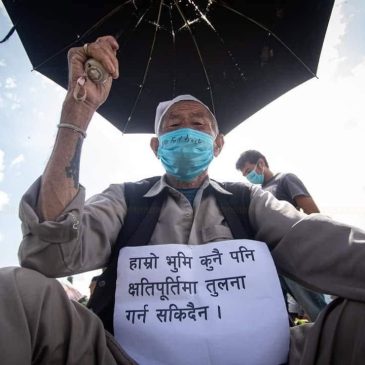
The communities have continued their peaceful advocacy despite the renewed uncertainty. For example, on 29 June 2026, they organised a demonstration during National Paddy Day in the agricultural fields of Khokana. Community members carried placards opposing the proposed alignment and starting point of the Expressway and called on the Government to adopt an alternative that would protect agricultural land, sacred sites, traditional irrigation systems, Guthi lands, historic settlements, cultural heritage and livelihoods.
In their letter, the communities have acknowledged that the engagement of the UN Special Procedures has contributed to some positive developments and has kept international attention on their situation. However, they have stressed that the republication of the land acquisition notice shows that their concerns and human rights issues remain unresolved.
The communities have therefore urged the UN Special Procedures to continue considering the situation under their respective mandates and to follow up with the Government of Nepal, businesses involved in the project, their home States and the Asian Development Bank regarding the recent developments and measures being taken to address the alleged violations of their rights. They have also invited the Special Procedures to visit Khokana, Bungamati and the wider affected communities to better understand the situation on the ground.
The follow-up information was jointly submitted to the UN Special Rapporteurs on the rights of Indigenous Peoples, in the field of cultural rights, on the rights on adequate housing as a component of the right to an adequate standard of living and on the right to non-discrimination, as well as the Working Group on the issue of human rights and transnational corporations and other business enterprises. The communities have urged the UN mechanisms to jointly examine the information and engage with the Government of Nepal and other relevant actors to defend, protect and promote their rights to their lands, resources, sacred places and culture.
Read the full letter here.
For further details or inquiries, contact Janasarokar Samiti, Khokana at khokanajanasarokarsamiti@gmail.com.